

How Photosynthetic Activity Scanners Help LivingSoiLL Track Vine Nitrogen
In a vineyard, much of what matters happens out of sight. Soil health, nutrient availability and root activity all shape the vine, yet growers can only judge them through what shows up above ground. Within the LivingSoiLL project, researchers are using a compact, portable tool to read one of the most important of those signals: the nitrogen status of the vine. It is called a photosynthetic activity scanner, a type of device sold under several names, such as N-Tester, Dualex or SPAD.
Why nitrogen matters
Nitrogen directly influences how vigorously a vine grows, how much it yields and the quality of the grapes it produces. Too little can hold back growth and productivity; too much can be wasteful and harmful to the environment. Keeping track of nitrogen status is therefore central to sustainable vineyard management, because it allows fertilization to be optimized while limiting environmental impacts.
For LivingSoiLL, the question is especially pointed. The project tests different vineyard management practices aimed at improving soil health. The researchers need to know whether those practices affect the vines’ nitrogen nutrition, and whether any of them have a negative impact on vine growth and performance. Soil management strategies can increase the competition for nitrogen that the vine faces, and this can affect yield. That is not directly a question of soil health, but it matters all the same: yield is the grower’s income.
How the scanner works
A photosynthetic activity scanner is a portable device that measures the intensity of selected wavelengths in the green range of a vine leaf, which reflects its chlorophyll content. Chlorophyll is the green pigment responsible for photosynthesis, and the plant’s ability to produce it is closely tied to how much nitrogen is available. The greener the leaf, the more active photosynthesis is, and a low reading points to a lack of nitrogen.
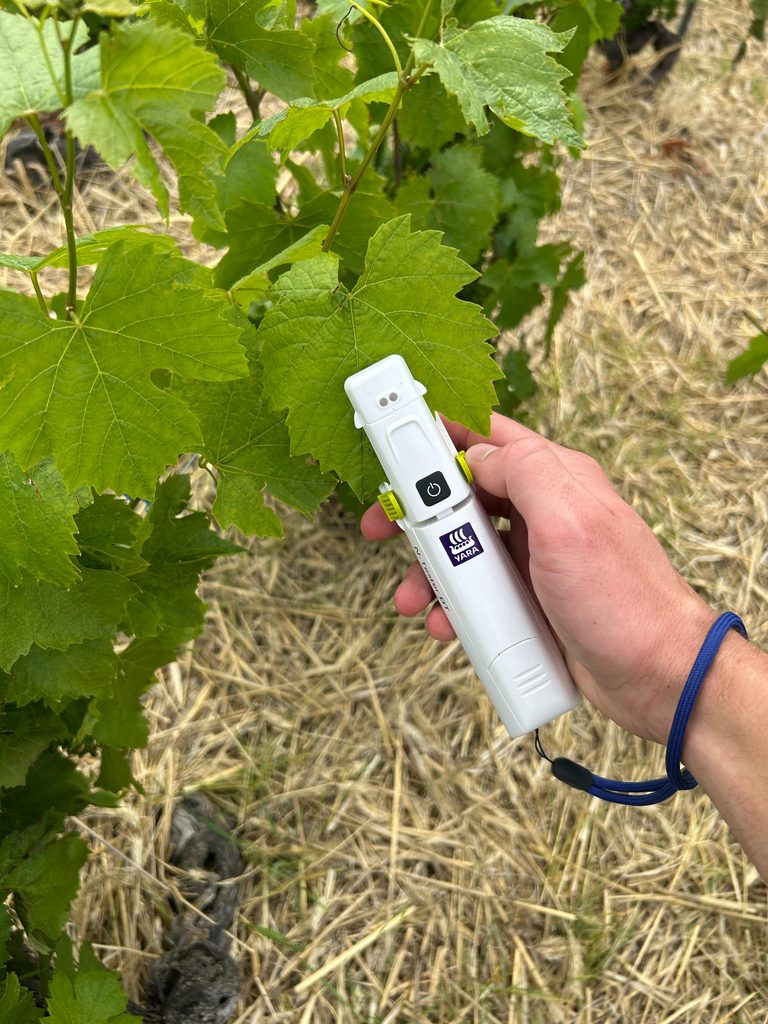
The measurement is rapid and non-destructive: no leaves need to be removed or sent to a laboratory. To get a value that represents the vine rather than a single leaf, measurements are taken on about 30 leaves and averaged. Other factors, such as the species and the variety, also influence leaf colour. For that reason, the readings are only meaningful when comparing several management practices within the same plot, not as absolute values.
Chlorophyll monitoring is one of several indicators collected across LivingSoiLL’s experimental sites. Most of the project’s measurements relate directly to soil health, while a few are taken on the plant to see how the tested strategies affect it. Photosynthetic activity is one of them, and it provides specific information on plant nitrogen nutrition that complements the other data. At some of the sites, it is the main indicator used to follow the nitrogen status of the vines. It also makes it possible to build corrective practices into the strategies when needed.
In LivingSoiLL, the measurement is usually carried out once a year, to check whether the tested practices differ from the reference. Where a difference is expected, it can be repeated several times during the season, at key stages of vine development such as flowering, fruit set and veraison. A single reading offers only a snapshot, while following how chlorophyll levels change from one stage to the next shows when a difference appears and how it develops over time, so that the most suitable corrective action can be proposed.
What it means for sustainable soil management
The aim is to identify soil management strategies that are good for both the soil and the vines. The scanner results show whether the practices under trial maintain an adequate nitrogen status in the vines. That makes it possible to pinpoint approaches that improve soil health while still supporting sustainable vine growth and production.
Sustainability rests on three pillars: environmental, social and economic. These results shed light on the economic one, by revealing potential effects of the practices on the vines’ nitrogen supply. Measuring yield alone is not enough, as yield losses can have several causes. But when a loss is measured and can be linked to the vines’ nitrogen nutrition, corrective practices are available.
It is a small device with a large role. By turning leaf color into useful data, the scanner helps LivingSoiLL find out which practices let vineyards look after their soils without compromising the vines they support.