

Stories from the field – Mauro Duretto
Born into three generations of winegrowers in the hills of Asti, Mauro Duretto has spent twenty years turning a family tradition into a pursuit of quality, one vineyard plot at a time.
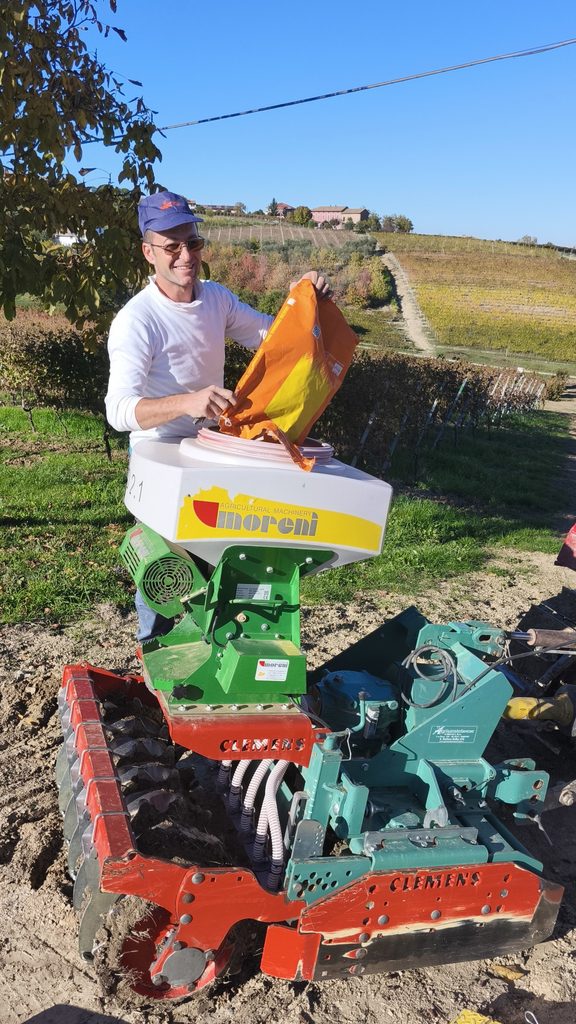
Wine runs in Mauro’s family. His grandfather already made it, and his father went on to cultivate vineyards in Costigliole d’Asti. Born in Asti in 1984, Mauro trained as an agricultural technician at the Vercelli-Penna Higher Education Institute, then took over his father’s farm.
In 2005, aged just 21, he joined the Barbera dei Sei Castelli Cooperative Winery in neighbouring Agliano Terme. He then managed 4 hectares of vineyards. Today, following the 2026 harvest, he manages 15. In 2022, his peers entrusted him with a seat on the cooperative’s Board of Directors.
Growth, for Mauro, has always gone hand in hand with quality. He joined the cooperative’s high-end selection programme, “Superbarbera”, with a single 3,800 m² vineyard. By the 2026 harvest, the area dedicated to the programme had grown to 30,000 m², a sign of how far the programme, and his confidence in his own Barbera, has come.
A member of the North-Western Italy – Piemonte Living Lab, Mauro shares what he has learned from the vineyard: how soil health shapes the grapes he grows, and what it means to carry a family legacy forward.
How has your approach to vineyard management evolved over the years?
Climate change has led me to change my cultivation practices. Rising temperatures, decreasing rainfall, and long periods without rain followed by periods of intense rainfall have forced me to adapt my farming practices, particularly soil management, in order to maintain the quality of my production. In the past, I did not tillage the soil. The abundant rainfall allowed me to maintain adequate vine vigour and yield. To increase the storage of rainfall during the post-harvest period, I started ripping the soil in 2007. The aim was to allow water to penetrate deeper into the soil during the rainy season and create a water reserve, using vertical soil loosening without turning the soil over. However, this was not enough. The vines continued to suffer from water stress to the point that I realised I needed to take further action.
Therefore, starting in 2015, I began fertilising the soil with mineral fertilisers, initially every other year and then every year. From 2020, I started using organo-mineral fertilisers, and since joining the LivingSoiLL project, I have used only organic fertilisers based on composted manure.
Despite these measures, production has declined over the years due to the increasingly irregular seasonal distribution of rainfall. I should point out that ours is hillside, non-irrigated viticulture.
How did you first become involved in the LivingSoiLL project and how are you involved in the activities of the North-Western Italy-Piemonte Living Lab?
I joined the North-Western Italy-Piemonte Living Lab thanks to the collaboration with Vite Colte, of which the Barbera dei Sei Castelli Cooperative Winery is a member. Our winery supplies Vite Colte with grapes for a wine produced according to specific requirements, which we call “Superbarbera”. I am one of the winegrowers who produce grapes for the high-end Superbarbera project.
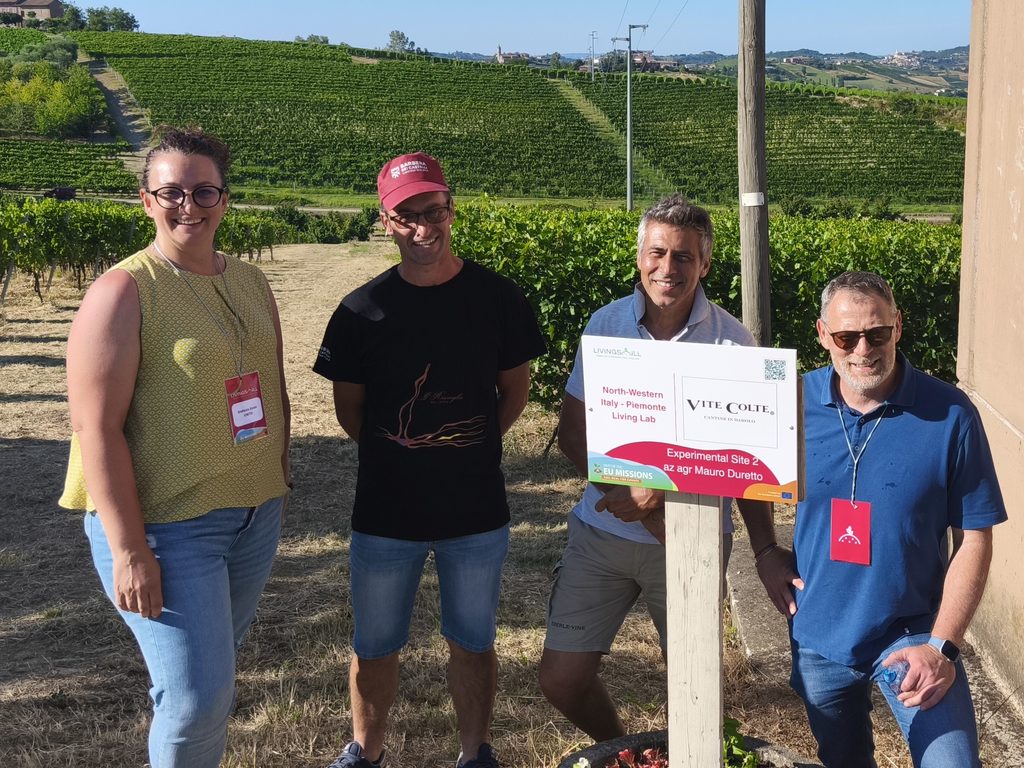
I adopt sustainable vineyard and soil management practices and use cover crops in my vineyard. I was therefore selected by our agronomist, Stefano Neri, to take part in the project. We are working together with the aim of mitigating the effects of climate change on the vineyard while maintaining the quality of the production.
What has been the most valuable aspect of participating in the Living Lab so far?
I am part of a cooperative. I believe that you can run faster on your own, but you can go further together. Taking part in the Living Lab has given me the opportunity to deepen my knowledge, develop soil management strategies in the vineyard to mitigate the effects of climate change, and exchange ideas and experiences with researchers, technicians and other winegrowers.
What are the main challenges currently facing winegrowers in the Piemonte region, particularly when it comes to soil management and climate change?
In my experience, the main challenge in soil management is maintaining or increasing soil organic matter by managing soil temperature and moisture, and developing cultivation practices that include the choice of the most suitable equipment and inputs to achieve this goal.
How do you see the adoption of more sustainable soil management practices among winegrowers?
Viticulture in Piedmont is traditionally rooted in long-established practices. This has helped preserve biodiversity and the distinctive style of our wines, but today, with climate change, sticking to traditional practices can also be a limitation. My aim is to achieve results through innovative soil management practices and to share them with all winegrowers in the area, so that they can benefit from them, not only those who are members of my cooperative.
How do you envision the future of viticulture in your region over the next 10 to 20 years?
The future of viticulture in my region, and especially of Barbera, will depend on how the climate changes, but also, and above all, on market trends, which are very worrying at the moment. Farmers and winegrowers will have to adapt to climate change by changing the way they manage their vineyards, but also by increasing the size of their farms to reduce production costs and remain competitive.
what message would you like to share with other farmers and winegrowers who are considering adopting more sustainable soil management practices?
The message I would like to share with other farmers, and especially with winegrowers in my area, is to get involved and be willing to try new approaches. With the support of researchers and skilled technicians, we should work on developing innovative soil management strategies, learn to share our experiences, work together, and be open to change.
We need to understand that healthy soils produce healthy food, but they also provide a healthier working environment and greater consistency in production. These are very important aspects for us winegrowers, considering how much time we spend in the vineyard managing our crops.
Finally, I would like to highlight that the role of agriculture in society and in policymaking is sometimes underestimated. Winegrowers play an important role in preserving the landscape, especially in Piemonte, where the vineyard landscapes have been recognised as a UNESCO World Heritage Site. This role is important not only from an aesthetic point of view, but also from a social and environmental perspective, as proper land management is essential for preventing hydrogeological hazards.